
Let's talk about the moment your mind leaves
You're with your partner. Everything is fine on the surface. But somewhere between the first kiss and now, you've mentally checked out. You're thinking about the work email you forgot to send, whether the kitchen has enough groceries, if your posture looks okay. Your body is there. Your mind is in three other places.
This is one of the most common things people don't talk about with partners. Disconnection during sex isn't about not loving them. It's not about attraction. It's about attention. And it's wildly fixable.
Why disconnection happens
Honestly, disconnection during partnered sex is usually one of three things operating alone or together.
Attention overload. When you're monitoring your partner's pleasure, your own body, the angle, the timing, whether it's been long enough or too long, your brain becomes a project manager instead of a pleasure receiver. You can't stay present when you're running a mental spreadsheet.
Sensation that's not quite right. If the stimulation isn't hitting the mark, your nervous system gets quiet. It stops signaling. Your brain interprets silence as "nothing interesting here" and wanders off. This is especially true if you're used to a different kind of pressure or rhythm than what's happening.
Relationship friction that's not being named. Sometimes disconnection is your nervous system's honest answer to unstated tension. A partner who hasn't been listening, resentment that hasn't been addressed, intimacy that feels performative instead of real. In these cases, a vibrator won't fix it alone. But naming it will.
The first two are where lemon clitoral vibrators genuinely help.
How lemon vibrators anchor you back into sensation
Here's the mechanical thing: lemon vibrators use air-suction stimulation, which creates a different sensory signal than traditional vibration. The sensation is more concentrated, more immediate to the nervous system. When your brain was drifting, a stronger signal pulls your attention back.
It's not forceful. It's just clearer. Think of it like turning up the volume on a song you like. The song doesn't change, but suddenly you're listening.
For partnered sex specifically, using a lemon vibrator while your partner is inside you or touching you serves a dual purpose. You get the focused sensation you need to stay present. Your partner gets the feedback that you're engaged. You're both receiving clear, consistent pleasure signals.
The practical setup that actually works
Introducing a lemon clitoral vibrator into partnered sex doesn't need to be a big conversation beforehand, though it can be. Many couples find it works best to simply bring it into the moment.
If you're receiving penetration, here's what I recommend: start with your partner inside you or about to enter. You hold the lemon vibrator. Start it on a lower setting (pattern 1 or 2 if you're using the Lem). Focus on your own sensation first for about 30 seconds. Let your nervous system quiet down and register what it's feeling.
Then talk to your partner. "I feel good. This is helping me stay with you." Concrete language matters. They need to know you're more present, not less.
If you're receiving oral sex, the lemon vibrator works best in a different configuration. Your partner continues what they're doing while you use the vibrator at a slightly different angle. The combination creates a layered sensation that's almost impossible to mentally escape from. Your brain has to stay online to process two distinct sensations at once.
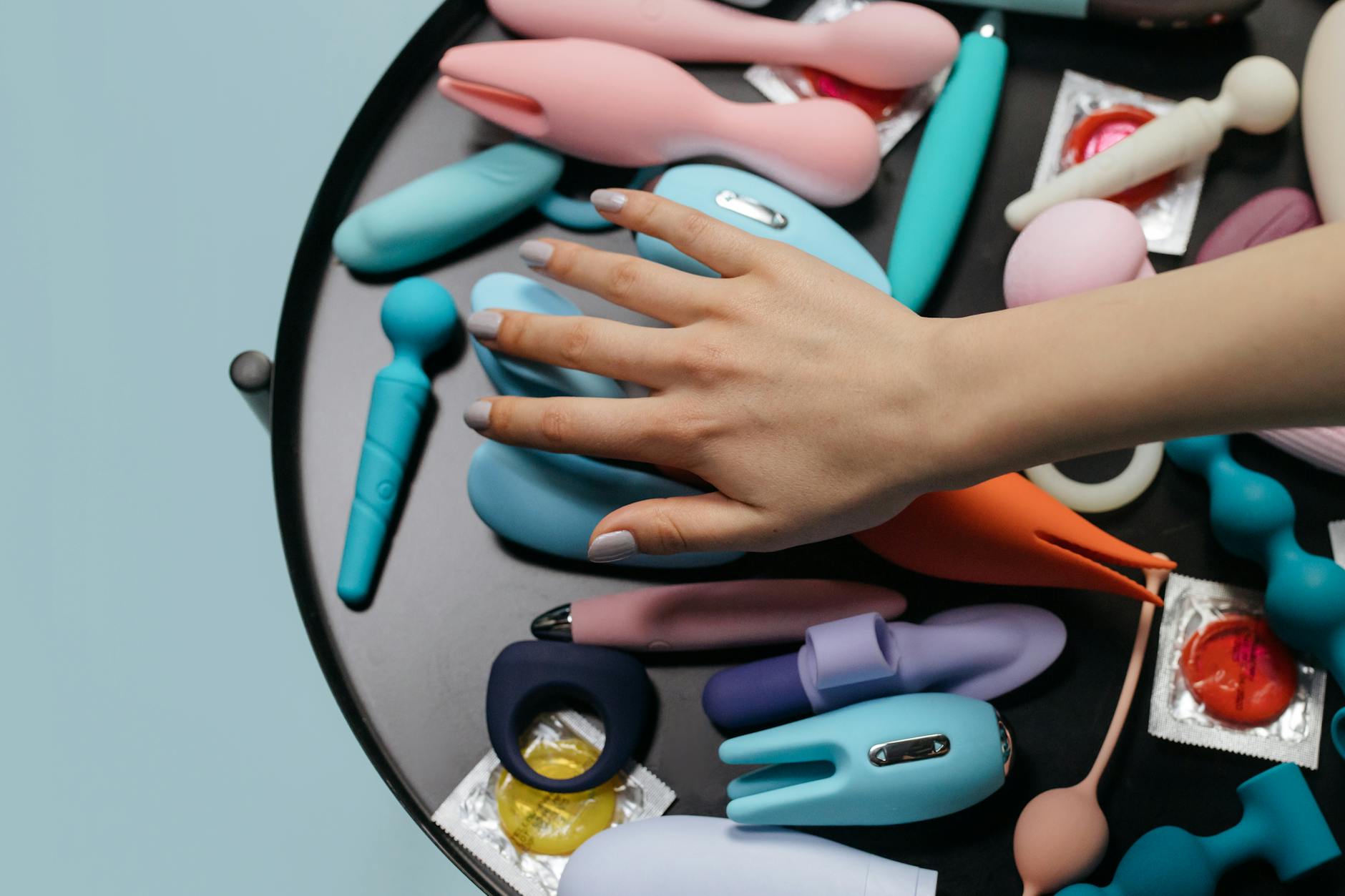
Photo by cottonbro studio on Pexels
The rhythm conversation you need to have
Disconnection during partnered sex often improves when you can name the rhythm you actually need. This is where most couples get stuck. You assume your partner knows. They assume you're enjoying what's happening. No one says anything. Disconnection deepens.
A lemon vibrator gives you a concrete way to show rather than tell. When you use it, your partner can observe what speed you're drawn to, what pattern keeps you engaged, how long you stay in a moment before your body asks for something different. They're learning your pleasure language in real time.
After, talk about it. "When I used the vibrator at that setting, I felt really present." "I loved watching you stay with me like that." Specific observation, not criticism. The goal is for your partner to understand: this is what presence looks like on your body.
When disconnection is about relationship friction
If the disconnection is rooted in unresolved conflict or resentment, a vibrator won't fix it. But it can create the opening for a real conversation.
Try this: next time you're feeling disconnected, pause before sex happens. Not in the moment. Earlier. "I notice I check out sometimes during sex. I think it's because I'm holding onto some tension from earlier. Can we talk about it?"
Most partners will say yes once they understand you're naming your own patterns, not blaming them. The conversation becomes collaborative instead of confrontational.
Then, when you do have sex again, you might find the disconnection has already started to lift because you've addressed the actual problem. The lemon vibrator becomes a pleasure tool, not a disconnection band-aid.
Setting intensity and pattern to match your focus
One advantage of air-suction lemon vibrators is the pattern options. If you're trying to stay present, experiment with which pattern keeps you engaged longest.
Some people need a consistent rhythm. They pick pattern 3 and stay there for 5-10 minutes. Others need variation. They cycle through patterns every minute or so. Neither is wrong. The right one is whatever keeps your attention.
Start lower than you think you need. Many people using a lemon vibrator for the first time during partnered sex go too high and overstimulate themselves. Low intensity lets you focus on the layered sensation of your partner plus the vibrator. High intensity can feel like sensory overload when you're already managing two inputs.
Your partner is watching you. That's part of the presence you're rebuilding. Let them see you paying attention to what feels good, adjusting, exploring.
The conversation after matters more than the tool
Here's what I've seen work in my practice. Couples use a lemon vibrator during sex once or twice. Then they talk about what shifted. "I felt like you were really there." "I could focus on us instead of my own head." "It was easier to stay connected."
That conversation is the actual repair. The vibrator is just the permission structure. It says: we can bring something new into this. We can ask for what helps. We can stay curious about each other's pleasure.
After you've used it a few times, some people keep it as a regular tool. Others find that the disconnection improves naturally once they've had the experience of being present, and they stop needing it. Both outcomes are fine.
The point is that disconnection during partnered sex is addressable. It doesn't mean your relationship is in trouble. It doesn't mean the attraction is gone. It usually just means your nervous system needs a signal strong enough to cut through the noise of your own thoughts.
People also ask
Will using a lemon vibrator with my partner make them feel inadequate?
Not if you frame it right. The framing is everything. "I want to use this to stay more present with you" is a completely different message than "I need this because you're not enough." One is collaborative. One is critical. Most partners respond positively to the first framing because it makes them feel wanted, not replaced.
How do I introduce a lemon vibrator into partnered sex if I haven't used one before?
Start alone. Spend 10-15 minutes exploring the patterns and intensity levels on your own. Get familiar with what feels good, which settings keep your attention, how your body responds. Then, when you bring it into partnered sex, you're not discovering the toy at the same time you're trying to stay present with a partner. You already know what you like.
Can I use a lemon clitoral vibrator during any position, or are some better than others?
Some positions are easier than others. Positions where you're on top, side-by-side, or receiving oral sex tend to work best because you have access and control. Positions where your partner is in charge of depth and rhythm can work too, but require more communication about pressure and angle. Experiment to find what works for your bodies.
What if my partner wants to use the vibrator on me instead of me using it myself?
That's a separate conversation worth having. Some people find it deeply intimate to have their partner control the vibrator. Others prefer the autonomy. There's no right answer. Talk about what each of you is curious about, then try it. You can always adjust.
How long should we use a lemon vibrator during partnered sex?
There's no time limit. Some people use it for 2-3 minutes as a warm-up. Others use it throughout. Pay attention to your own body's signals. When you feel like the sensation has shifted or you want something different, that's your cue to change pace, intensity, or approach. Your partner should be checking in with you too. "Still feeling good?" is a simple question that keeps both of you connected.
Is disconnection during partnered sex common?
Completely normal. Studies suggest that at least 50% of people experience some form of mental disconnect during partnered sex at some point. It's not a sign that something is fundamentally wrong. It's usually just a sign that your nervous system needs a stronger signal or your relationship needs a more honest conversation. Both are fixable.
What happens when you stay present
When you use a lemon vibrator and actually stay present with your partner, something shifts. Not just for you. For both of you.
Your partner feels the difference. They see that you're engaged, that you're responsive, that you actually want to be there. That changes the entire texture of sex. It becomes less performative and more real.
For you, staying present means you actually get to experience pleasure instead of running a mental to-do list. You remember why you wanted this person. You feel wanted back.
If disconnection has been the pattern, this might be the first time in a while that sex feels like something you're both doing together instead of something you're both doing near each other.
That's what the tool is really for. Not the vibration itself. The permission to ask for what helps you stay real.
Ready to explore what works for your body? Reach out if you want to talk through how to bring this conversation to your partner. You deserve sex that feels connected.